
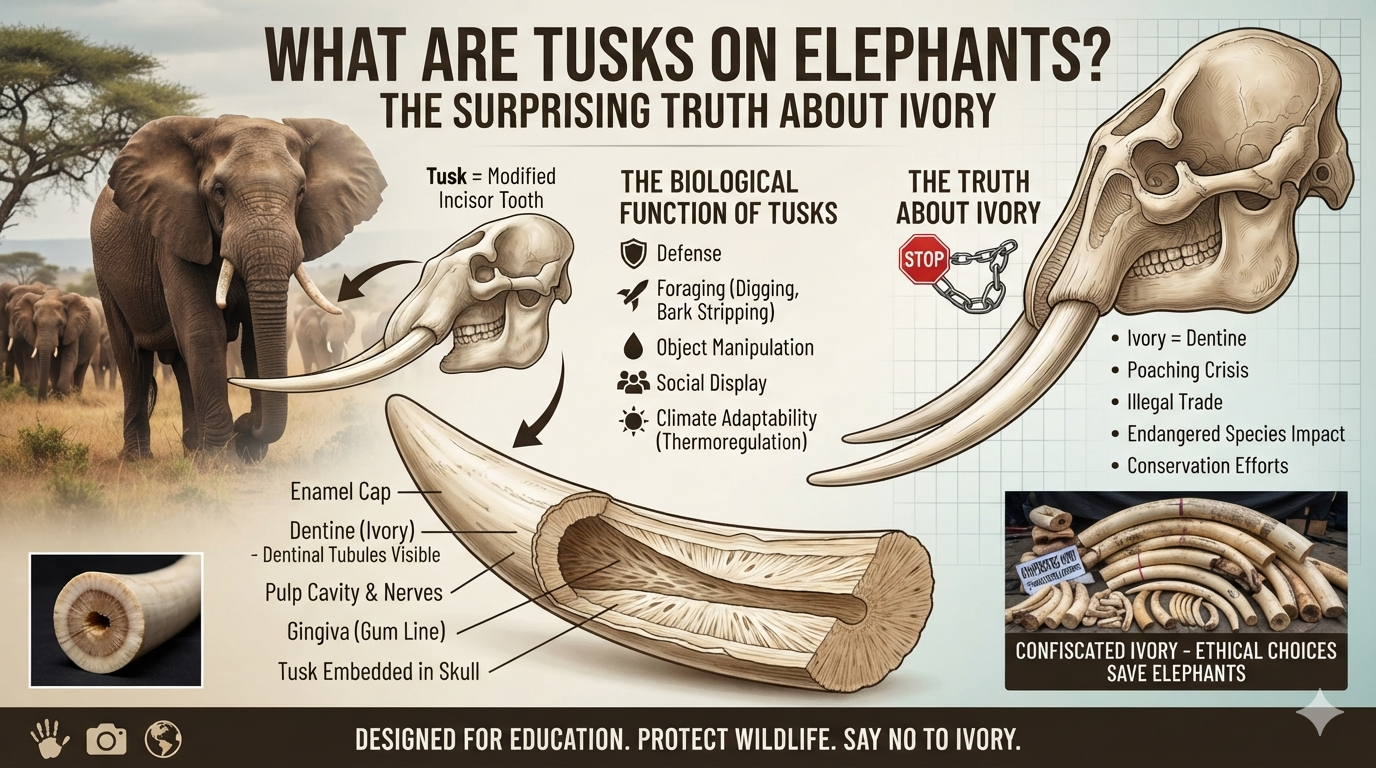
Have you ever looked at a giant elephant and wondered about those long, white teeth pointing out of its mouth? Those beautiful, curved structures are called tusks. They are among the most amazing features in the entire animal kingdom.
But what exactly are they, and why do these gentle giants have them? Today, we are going to dive deep into the science, history, and mysteries surrounding tusks on elephants. We will explore how they grow, how elephants use them, and clear up some famous internet rumors along the way. Let’s get started!
What Are Tusks on Elephants?
When we look closely at what are tusks on elephants, we find an amazing biological fact. Tusks are not extra bones or horns. They are actually giant teeth! Specifically, they are extremely long incisors, which are the same as our front teeth.
These teeth grow out of the elephant’s upper jaw. Unlike our teeth, which stop growing after we reach a certain age, these special teeth keep growing throughout the elephant’s entire life. They are made of a dense, bone-like material called ivory, covered by a thin layer of protective enamel when the elephant is young. Over time, the enamel wears off, leaving the smooth ivory exposed.
What Are Tusks on Elephants Used For?
Elephants do not just have these long teeth for display. If you have ever wondered what are tusks on elephants used for, the answer is almost everything! These structures act like built-in multi-tools that help them survive in the wild every single day.
First, elephants use them as shovels to dig for water, salt, and nutritious roots deep under the dry ground. Second, they act like crowbars to strip thick bark off trees, which is one of their favorite foods. Third, they help clear paths through thick forests so the herd can walk safely. Finally, they are used for defense to protect their babies from predators like lions.
Left-Tusked vs. Right-Tusked Elephants
Just like humans are usually right-handed or left-handed, elephants have a preferred tusk! They will use one side much more than the other when digging, lifting heavy branches, or stripping bark.
Scientists can easily tell which side an elephant prefers just by looking at them. The preferred tusk is always shorter and more rounded at the tip. This happens because constant daily work wears down the ivory over time. Next time you see a picture of an elephant, look closely at the tips to see if you can spot their favorite side!
The Rumor: Pink Tusks on Elephants and Rhinos
If you spend any time on social media, you might have seen a viral post showing bright pink tusks on elephants and rhinos. The story online claims that conservationists are injecting a safe, bright pink dye into the ivory of live animals.
According to these posts, the dye ruins the value of the ivory, making it worthless to poachers while keeping the animals perfectly safe and healthy. It sounds like a brilliant, colorful solution to a very sad and real problem. Many people shared these posts hoping it was the ultimate key to saving wildlife.
Pink Tusks on Elephants: Is It Real?
While the idea of pink tusks on elephants sounds wonderful, we have to look at the hard science. In reality, this is not a real conservation practice. It is physically impossible to dye a living elephant’s tusks pink.
Unlike horns, which are made of keratin (like our fingernails) and have small tubes inside, ivory is solid, dense tooth material. A dye cannot soak into solid ivory. Even if someone painted the outside of the tusk, the paint would quickly wear off as the elephant digs in the dirt and scrapes against rough tree bark.
What Does Snopes Say About Pink Tusks on Elephants?
If you check the famous myth-busting website, searching for pink tusks on elephants snopes will give you a very clear answer: False. The viral images you see online are actually clever digital edits created with photo-editing software.
Snopes pointed out that while some rhinos have had their horns infused with special toxins and dyes to stop poachers, this does not turn them bright pink. Furthermore, doing this to tusks on elephants is not done because it simply does not work on ivory. The images online are purely fictional.
The Real Crisis Facing Elephant Tusks
Even though the pink dye story is a myth, the threat to tusks on elephants is incredibly real. Elephants are heavily targeted by illegal hunters, known as poachers, who want to steal their ivory to sell it on the black market.
This intense hunting pressure has had a devastating effect on elephant populations across Africa and Asia. It has also triggered a strange evolutionary shift. Because elephants with large tusks are hunted more often, they are less likely to reproduce, leading to a major biological change in the species.
The Rise of Tuskless Elephants
Because of heavy poaching, nature is fighting back in a very unique way. More and more baby elephants are being born completely without tusks.
In areas that suffered from heavy poaching in the past, a high percentage of female elephants are now naturally tuskless. While this keeps them safe from hunters, it makes their daily life much harder. Without these vital tools, it is difficult for them to dig for water during droughts or strip bark from trees for food.
Comparing Asian and African Elephant Tusks
Not all elephants are the same, and their teeth show major differences depending on where they live. Let’s look at the differences between African and Asian species:
| Feature | African Elephants | Asian Elephants |
| Who Has Them | Both males and females | Only some males (called Tuskers) |
| Average Size | Very large, heavy, and curved | Smaller, lighter, and straighter |
| Usage | Heavy digging, defense, and clearing forests | Light digging and moving vegetation |
How We Can Protect These Majestic Animals
Protecting elephants starts with stopping the demand for ivory. Many countries have banned the sale of ivory completely, which has helped slow down illegal hunting.
You can make a difference by supporting trusted wildlife conservation organizations. These groups hire rangers to patrol national parks, use satellite tracking to watch over herds, and work closely with local communities to ensure humans and elephants can live together in peace.
Frequently Asked Questions
What are tusks on elephants?
Tusks are actually enlarged incisor teeth that grow out of the elephant’s upper jaw. They are made of ivory and continue to grow throughout the animal’s entire life.
What are tusks on elephants used for in the wild?
Elephants use them for digging for water and salt, peeling bark off trees, clearing heavy brush, and defending themselves from predators.
Is the story about pink tusks on elephants and rhinos true?
No, it is a myth. The viral photos online showing bright pink tusks are digitally edited. Solid ivory cannot absorb dye, and any outer coloring would quickly wear off in the dirt.
Do female Asian elephants have tusks?
No, female Asian elephants do not grow tusks. Only some male Asian elephants grow them, while both male and female African elephants grow them.
What is the pink tusks on elephants snopes rating?
Snopes rates the claim as completely false. They confirmed that the images are photoshop creations and that conservationists do not dye ivory pink.
Why are some elephants being born without tusks now?
Due to years of intense poaching, elephants with large tusks were hunted. Those without them survived and passed on their “tuskless” genes to their babies.
Conclusion
Elephants are incredibly intelligent, emotional creatures, and their tusks are a beautiful part of who they are. Now that you know the true science behind these amazing natural tools—and know how to spot fake internet rumors—you can help spread real awareness.